Everyday AI users
Your next chat should remember the last useful answer, the files that mattered, and the decision you already made.
Start with MemQ, the flagship memory layer for people and teams using AI every day. Save context once, recall it across tools, and hand it to the next agent or teammate with boundaries intact. Add Shield adds the security control plane when sensitive prompts, files, and browser workflows need policy before scale.
Live handoff preview
One approved memory follows the work across tools, agents, and people.
Codex
Build
Gemini
Reason
Hermes
Operate
OpenClaw
Execute
MemQ recall
Team handoff
The next operator starts with context
No repeat kickoff. No lost decision. No unpaid context rebuild.
The Multinex operating stack
Most AI rollouts fail because context disappears between tools, teams, and approvals. Multinex starts with MemQ so the first proof is simple: save the decision, restart the session, and keep moving.
Your next chat should remember the last useful answer, the files that mattered, and the decision you already made.
Agents should inherit repo decisions, implementation constraints, and handoff notes instead of reopening the same work.
Roll out AI memory with approval paths, role boundaries, retention posture, and evidence leadership can audit.
01
Make every AI session remember the work.
Save the decisions, preferences, repo facts, and customer context once. MemQ gives the next tool, teammate, or agent the approved memory it needs to continue.
Start with MemQ02
Adopt AI without exposing sensitive work.
Give teams AI access with prompt, file, browser, and tool-action boundaries in place before private context reaches an unmanaged workflow.
Control AI risk03
Get approved agents working together.
Give Codex, Gemini, Hermes, OpenClaw, and internal agents shared memory, approval checkpoints, and handoffs your team can review.
Start Legion04
Convert intent into activated access.
Move buyers from plan choice to checkout, entitlement, provisioning, and follow-through without losing momentum between systems.
Plan ACO05
Automate only where the risk is governed.
Use memory-backed market workflows with policy limits, evidence, and human review points before an automated trading path touches production.
Review controls06
Show the MemQ story before the first call.
Turn the same buyer proof into reviewable explainers, onboarding clips, and sales assets without drifting from the Multinex brand system.
Watch explainerMemQ explainer review cut · 65 seconds
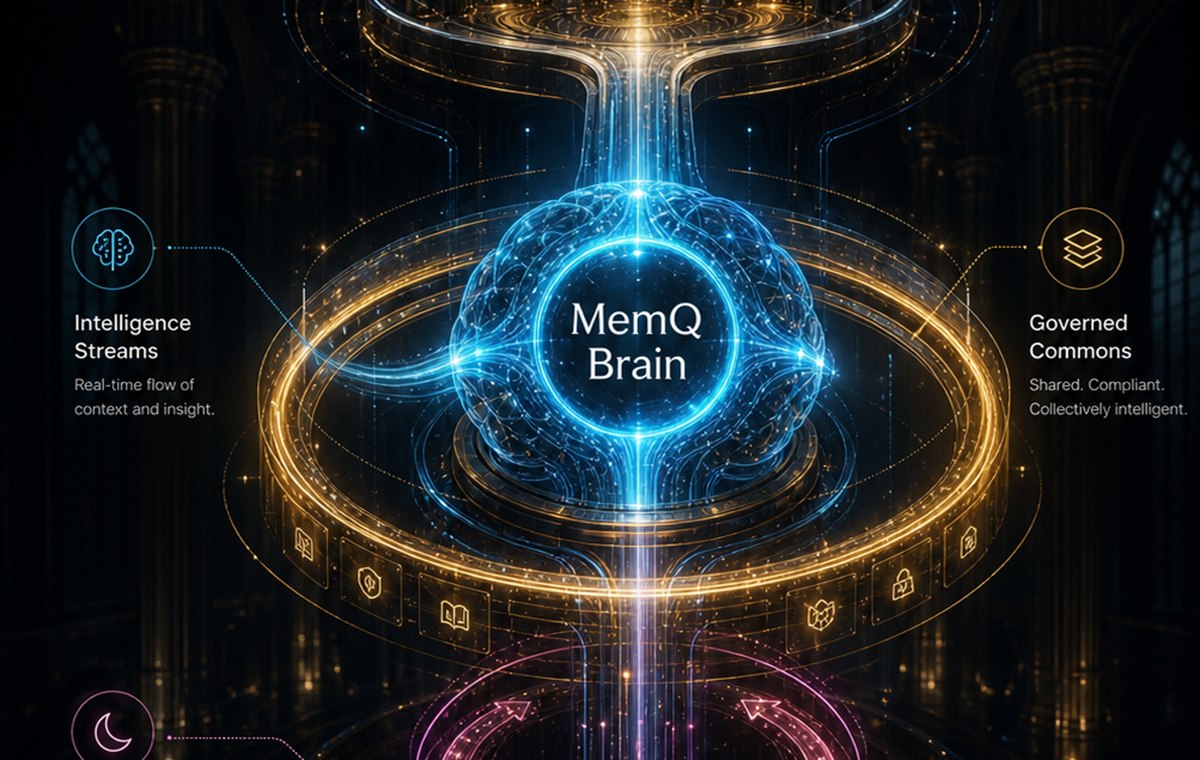
The new cut explains MemQ for anyone using AI systems: durable memory, the Dreamer daemon, namespaces, Airlock VISA, and immediate handoff across tools and teams.
00:00
The reset problem
AI keeps asking for work you already explained.
00:07
Shared memory
MemQ stores the approved facts once.
00:14
Memory layers
Hot, warm, cold, and engine tiers keep context usable.
00:25
Dreamer daemon
Lessons consolidate after the work ends.
00:33
Any-to-any handoff
Codex, Gemini, Hermes, and OpenClaw receive context.
00:42
Namespaces
Team memory stays separated by role and scope.
00:50
Airlock VISA
Sensitive context moves only through explicit boundaries.
00:58
Resume ready
The next teammate starts with the useful state loaded.
Review the buyer explainer
The video opens with a familiar problem, then shows how MemQ turns one approved memory into any-to-any agent context, team handoff, governed namespaces, and safer expansion into the Multinex stack.
Why buyers choose MemQ
MemQ stores context with the operational state around it: who approved it, where it can move, which agent needs it next, and how the team can resume without starting over.
Start self-serve when the pain is personal or team continuity. Use the rollout path when governance, agents, checkout automation, or trading workflows are part of the business case.
Connect one tool, save one useful decision, restart, and see the context come back before you ask the team to change behavior.
Use the demo path when the buyer case spans MemQ, Multinex Shield, Legion, ACO, or risk-governed trading workflow review.
